Earbuds are everywhere. Tiny, wireless, convenient — they've become the default way most people listen to music, take calls, and tune out the world. And while they're undeniably practical, there's a growing body of evidence that our collective love affair with in-ear headphones is quietly doing damage we won't fully appreciate for another decade.
This isn't fearmongering. It's anatomy. And once you understand what's actually happening inside your ear canal, you'll think twice before defaulting to earbuds for every listening session.
"Your hearing is one of the few senses you can permanently damage just by choosing the wrong gear. It's worth paying attention to."
How Hearing Damage Actually Happens
Deep inside your inner ear are tiny hair cells called stereocilia. These cells convert sound vibrations into electrical signals that your brain interprets as sound. The critical detail: once these cells are damaged or destroyed, they do not regenerate. Ever. Unlike most cells in your body, there's no repair mechanism, no regrowth — the loss is permanent.
Sound is measured in decibels (dB). Prolonged exposure to sounds above 85dB causes cumulative damage. A normal conversation sits around 60dB. A typical earbud at 60–70% volume? Around 85–100dB. Many people listen at higher volumes than that. The World Health Organization estimates that over 1 billion young people are at risk of noise-induced hearing loss from unsafe listening habits — primarily from personal audio devices.
The Problem Specific to In-Ear Headphones
They Sit Directly in the Ear Canal
This is the fundamental issue. In-ear headphones (earbuds, AirPods, IEMs) seal inside or just outside the ear canal, placing the speaker driver millimetres from your eardrum. There is no distance for sound to dissipate. The full force of the audio hits your eardrum directly, at concentrated intensity. Over-ear headphones sit 2–3cm away from the ear canal — that distance matters enormously in terms of sound pressure reaching the eardrum.
They Encourage Higher Volume Listening
Because earbuds sit in your ear, ambient noise bleeds in around them — especially the non-noise-cancelling kind. Our natural response is to turn the volume up to compensate. This is called the Lombard effect, and it's reflexive — we do it without thinking. Over-ear headphones, especially closed-back designs, passively block more external noise, meaning you don't need to compete with your environment to hear your audio clearly.
The Occlusion Effect and Ear Canal Health
Sealing the ear canal with earbuds creates an occlusion effect — it traps moisture, raises the temperature inside the canal, and alters the natural acoustic environment of the ear. Extended wear can promote bacterial growth, increase ear wax buildup, and cause ear canal irritation. For people who wear earbuds for 6–8 hours a day (increasingly common for remote workers), this becomes a genuine health consideration.

Why Over-Ear Headphones Are the Healthier Choice
Greater Physical Distance from the Eardrum
Over-ear (circumaural) headphones sit around the ear, not in it. The speaker driver is held away from the ear canal, allowing sound waves to travel a short distance before entering the ear. This distance reduces the direct sound pressure on the eardrum compared to in-ear designs at equivalent volume levels. It's a simple physics advantage that makes a meaningful difference over years of use.
More Natural Sound Reproduction
Open-back over-ear headphones — like the Sennheiser HD 599 SE — allow air to pass through the ear cups, creating a more natural, spacious soundstage. Sound doesn't feel like it's coming from inside your skull; it feels like it's coming from around you, which more closely mimics how we naturally hear. This natural presentation also tends to reduce listening fatigue — that headache-y, drained feeling you get after hours of earbud use — because your auditory system isn't working as hard to process an unnaturally close, enclosed sound source.
Passive Noise Isolation Without Sealing the Canal
Good over-ear headphones block ambient noise through physical ear cup design — padded cups that cover the ear — rather than by plugging the canal itself. Your ear canal remains open and in its natural state. No moisture trap, no occlusion, no pressure buildup.
Lower Listening Volumes for the Same Perceived Loudness
Because over-ear headphones deliver sound more efficiently at distance and block ambient noise passively, most people find they listen at lower volumes for the same level of perceived clarity. Lower volume, same listening experience — that's the definition of a healthier audio habit.
"Switching to over-ear headphones is one of the easiest, most overlooked health upgrades for anyone who listens to audio for hours each day."
Safe Listening Guidelines

🛒 Recommended Product
SEDETA Electric Standing Desk 63"
Height-adjustable with 3 drawers, storage shelves, and built-in power outlets. Your back and your productivity will both improve.
Shop on Amazon →Affiliate link — we may earn a small commission at no cost to you.
Regardless of which headphones you use, these habits protect your hearing:
- The 60/60 rule: Listen at no more than 60% of maximum volume for no more than 60 minutes before taking a break
- Check your volume: If someone standing next to you can hear your audio, it's too loud
- Take ear breaks: 10–15 minutes of silence per hour of listening gives your auditory system time to recover
- Avoid earbuds in loud environments: The noise-competing reflex will push your volume dangerously high — use over-ear headphones with passive isolation instead
- Get periodic hearing checks: Especially if you're a heavy daily listener — early detection of high-frequency loss allows you to adjust habits before damage compounds
Our Recommendation: Sennheiser HD 599 SE
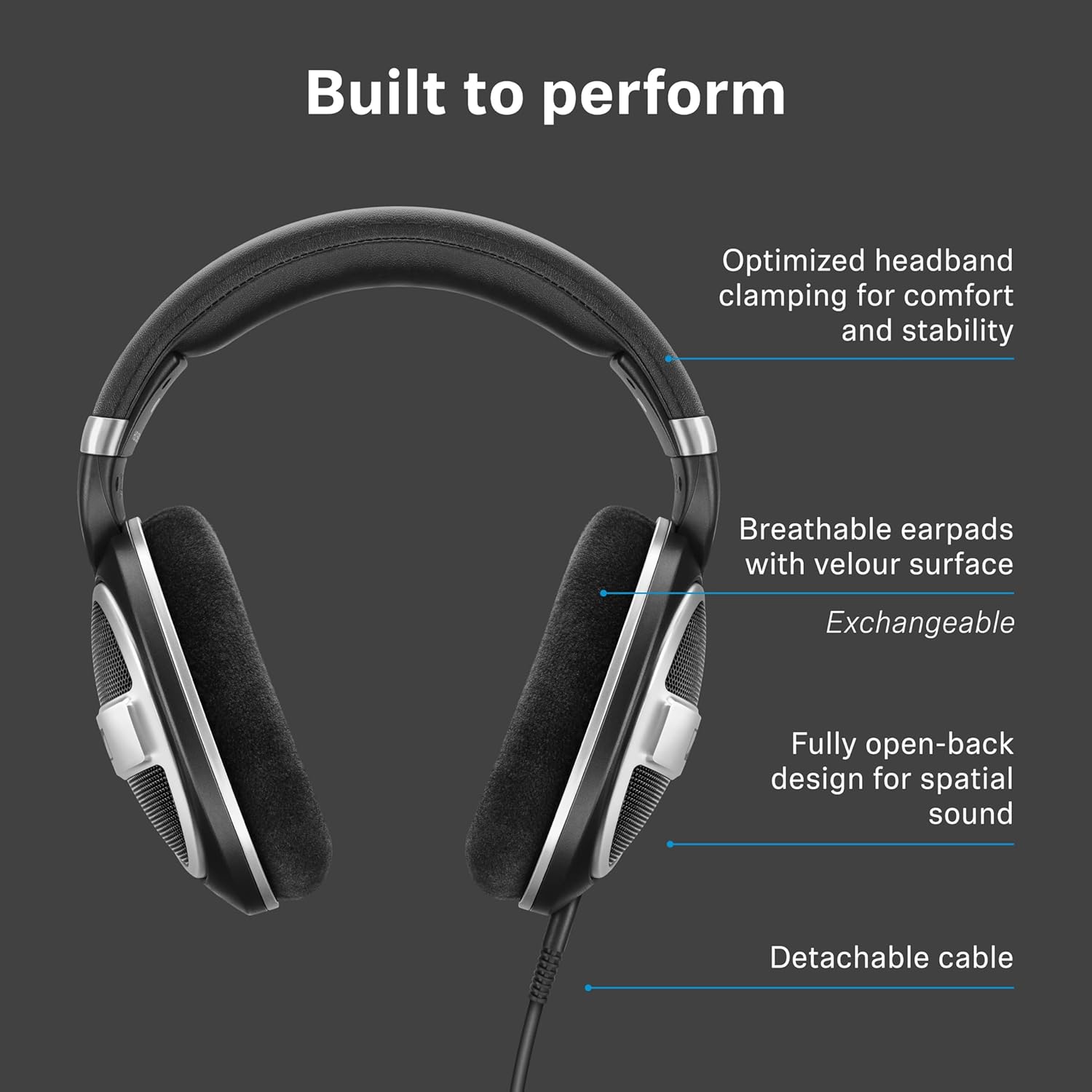
🛒 Recommended Product
Sennheiser HD 599 SE Open-Back Headphones
Natural balanced audio, comfortable all-day fit, open-back design for healthier listening. The upgrade your ears have been waiting for.
Shop on Amazon →Affiliate link — we may earn a small commission at no cost to you.
If you're spending hours at a desk every day — working, studying, on calls — your headphones are a health decision as much as a sound quality one. The Sennheiser HD 599 SE open-back headphones deliver a wide, natural soundstage that dramatically reduces listening fatigue compared to closed or in-ear designs. The open-back design means your ears breathe, the over-ear fit keeps the drivers at a healthy distance from your eardrums, and the balanced audio profile means you won't need to crank the volume to hear clearly.
Comfortable enough for all-day wear, wired so there's no Bluetooth compression, and built to last — this is the kind of headphone that's genuinely good for you, not just good sounding. Your ears will thank you in 20 years. And honestly, they'll thank you tomorrow morning too.
References
- World Health Organization. "Deafness and hearing loss." WHO Fact Sheet. Geneva: WHO; 2023. who.int
- Jiang W, et al. "The effects of noise on hearing and cardiovascular system." Journal of Biomedical Research. 2017;28(4):197–202.
- Punch JL, Paton J. "Headphone listening habits and hearing health in college students." Language, Speech, and Hearing Services in Schools. 2021;52(3):797–810.
- Portnuff CDF, Fligor BJ, Arehart KH. "Teenage use of portable listening devices: A hazard to hearing?" Journal of the American Academy of Audiology. 2011;22(10):663–677.
- Killion MC. "Myths about hearing in noise and directional microphones." The Hearing Review. 2004;11(2):14–19, 72–73.
Upgrade Your Listening Setup 💼
The Sennheiser HD 599 SE — premium open-back sound that's as kind to your ears as it is to your focus.
Shop on Amazon →